Showing posts with label Exhibit. Show all posts

Thursday, May 8, 2014

Ask a Curator: Bonnie Gurewitsch, Beyond Swastika and Jim Crow Part Two

Today, we continue our two-part interview with Bonnie Gurewitsch, the curator of our new exhibit, Beyond Swastika and Jim Crow: Jewish Refugee Scholars at Black Colleges. You can read part one here.


What would you like visitors to take away after viewing the exhibit?

My own experience of studying with a black professor at Brooklyn College in 1961-1962 was a highlight of my undergraduate experience. It was my first encounter with a black scholar, and it opened my eyes to the encounter between cultures and the pre-conceived notions people can have about each other. I saw how this played out in the Beyond Swastika story. I would hope that visitors would take away the lesson that the universal values of equality, fairness and kindness are applicable to all people.

How can the experiences of those profiled in the exhibit become lessons for present day students?

The experience of the scholars-immigration and integration into a new society-will resonate with many visitors who are themselves new Americans. Visitors might identify with the strong motivations of the students, who came from backgrounds that were deprived of material things but not of aspirations and the values of hard work. That two such different groups could come together to share experiences, skills, and knowledge and create an integrated world of mutual appreciation on campus, is a model of peaceful co-existence that would be useful today.


***
About Bonnie Gurewitsch
Bonnie Gurewitsch recently retired as an Archivist and Curator at the Museum of Jewish Heritage- A Living Memorial to the Holocaust, in New York City. She has been a Holocaust educator and oral historian for more than 40 years, Ms. Gurewitsch was a pioneer in the effort to develop a systematic approach to recording and cataloging Holocaust oral history. Ms. Gurewitsch lectures frequently and has served as consultant to several scholarly and educational projects, including the Survivors of the Shoah Visual History Foundation, founded by Steven Spielberg. 

A SURPRISING CONNECTION
A REMARKABLE LEGACY

Beyond Swastika and Jim Crow tells the compelling but little known story of Jewish professors who fled Nazi Germany during WWII, came to America and found teaching positions at historically black colleges and universities in the South. There they came face to face with the absurdities of a rigidly segregated Jim Crow society.

Discover the connections and encounters between these refugee scholars and their students, and their great impact on each other, the Civil Rights Movement, and American society.

Beyond Swastika and Jim Crow: Jewish Refugee Scholars at Black Colleges is on display now through September 14. 

Be sure to follow us on Twitter, tag us on Instagram and like us on Facebook. Share with your community and leave a comment below. 

Wednesday, December 11, 2013

Ask an Artist!: A View From The Other Side

View from the Other Side features local artists' response to the previous exhibit, Network of Mutuality: 50 Years Post-Birmingham. The artists created pieces working within the topic of Civil Rights struggles in our region. Both exhibits are a part of the Museum's two-year series, Destination Freedom: Civil Rights Struggles Then and Now. To bring further insights into the exhibit, we took the opportunity to ask the artists about their artwork, what in history inspired them to create it and what they hope guest gain from their art. 

Next up: Antoine Williams, Local Artist and Designer

What part of history inspired your artwork?
When it comes to history, I'm interested in how human beings have interacted with one another. Therefore, points in time when one group exerts power over another and reaction that produces. More specifically, slavery up to Jim Crow and the civil rights movement, American military history, also the relationship between the ruling class and average people.

What do you hope guest experience when viewing your artwork?

Evoking any type of emotion is of particular interest to me. The view completes the piece. So, I hope they bring their own experiences to the work, coupled with what I've created maybe they can come to their own conclusions.

What roles does the community play in your art?

My work is a look at how socioeconomic factors can affect ones cultural identity, therefore, the art I'm creating is heavily influenced by the communities I grew up with and the ones I currently exist in now. 

What other imagery/ stories do you explore within your work?
Lately, I've been interested in merging representations of contemporary people from various social strata with early 18th century animal illustrations, as a look into how we create monsters out of those we deem different than ourselves.

Learn more about Antoine on his Tumblr and website.

Come view Antoine and other's artwork in the View from the Other Side exhibit at the Levine Museum, on display through February 2, 2014. 

Have you seen Antoine's artwork? Tell us what you think below.

Be sure to follow us on Twitter, tag us on Instagram and like us on Facebook.

Thursday, December 5, 2013

Ask an Artist!: View From The Other Side

View from the Other Side features local artists' response to the previous exhibit, Network of Mutuality: 50 Years Post-Birmingham. The artists created pieces working within the topic of Civil Rights struggles in our region. Both exhibits are a part of the Museum's two-year series, Destination Freedom: Civil Rights Struggles Then and Now. To bring further insights into the exhibit, we took the opportunity to ask the artists about their artwork, what in history inspired them to create it and what they hope guest gain from their art. 


Next up: Rosalia Weiner, Local Artist and Founder of Project Art Aid


What part of history inspired your artwork?

My work is heavily influenced by current events. In my view, what is happening with immigrant rights, immigration reform, and the rise of Hispanic culture in America is historic.

What do you hope guest experience when viewing your artwork?

I hope that guest experience the vibrant colors of my Mexican culture, and I also hope that my work broadens their perception of immigration issues.

What role does the community play in your art?

The community plays a very important role in my work. My work is often based on their stories and experiences, and art is my tool for giving voice to the issues that are affecting us. 

What other imagery/stories do you explore within your work?

I have also told love stories with my art. In a recent commission, I narrated the story of a couple and blended family, with images detailing the places where they were from, where they met, and distinct aspects of their personalities and style. 


Come view Rosalia and other's artwork in the View from the Other Side exhibit at the Levine Museum, on display through February 2, 2014. 

Tell us what you think of Rosalia's work in the comments below and share with your friends!


Be sure to follow us on Twitter, tag us on Instagram and like us on Facebook.

Monday, November 25, 2013

Ask an Artist!: View from the Other Side

View from the Other Side features local artists' responses to the exhibit, Network of Mutuality: 50 Years Post-Birmingham. The artists submitted pieces related to the topic of Civil Rights struggles in our region. Both exhibits are presented as part of the Museum's two-year series, Destination Freedom: Civil Rights Struggles Then and Now. To bring deeper insights into the exhibit, we asked the artists to talk about their work and share what in history inspired them and what they hope guests gain from their art. 

Next up: Mikale Kwiatkowski, Local Artist and UNC Charlotte School of Architecture Teaching Fellow

What part of history inspired your artwork?
Feminist theory from the 1970's to the present was the starting point for my research, and queer theory from the early 1990's to the present became an even more influential driver during my actual making process. In addition, artists like Rebecca Horn and Rachael Whiteread continue to  be influential. 

What do you hope guests experience when viewing your artwork?
Honestly, my greatest hope is that my piece will prompt new thought in viewers -- that people who have never before considered how they publicly perform identities like gender and sexuality might consider culturally constructed scripts that they have adopted as their own. I have no issue with conscious choices people make around these identities  but I firmly believe many people unconsciously follow socially prescribed scripts instead of making choices from the stronger vantage point of awareness. 

What role does the community play in your art?
Community, well it plays a big role I guess. Cultural ideology is embedded within communities. There is a lot to like about Charlotte, but the conservative nature of the city is its own obstacle for progressive growth. The effort that Levine Museum of the New South makes in bringing awareness to normalizing ideology is striking and extremely valuable in a community like Charlotte's.

What other imagery/ stories do you explore within your work?
 For the time being, I am focused on creating experiential assemblages that attempt to disrupt or destabilize processes of normalization that exist in Western culture.


Come view Mikale and others' artwork in the View from the Other Side exhibit at Levine Museum, on display through February 2, 2014. 

Be sure to follow us on Twitter, tag us on Instagram and like us on Facebook.

Sunday, September 8, 2013

Destination Freedom...Four Little Girls


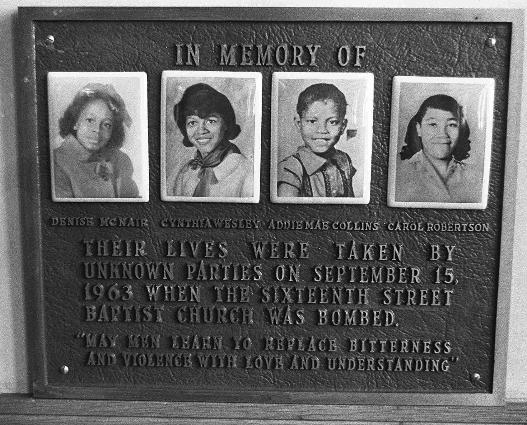
Plaque commemorating the four girls killed in the 16th Street
Baptist Church Bombing
Our kickoff for the Destination Freedom series is scheduled for one week from today on Sunday, Sept. 15. The timing of the event is meant to be commemorative.

If you have been following this blog and the Civil Rights timeline, the reasons are insurmountable. On Sept. 15, 1963, the 16th Street Baptist Church in Birmingham, Alabama, was bombed after the KKK planted dynamite in the church’s basement. The bombing killed four young girls: Addie Mae Collins, 14; Denise McNair, 11; Carole Robertson, 14; and Cynthia Wesley, 14.

News of the bombing shook the nation. Everyone, including Dr. King, heard what happened and then had to ponder: what kind of hate and racism would allow the killing of young girls at their church on a Sunday morning?
Yet despite the public outrage, it took years to convict the perpetrators of the crime. It has taken years more to answer other questions that the tragedy brings to the fore:
Have we as a nation made it possible for young people (of every color) to feel safer?

Are those who would use violence to further their ideology more likely to be brought to justice today?

Who else, or where else, might be a target for those looking to send a message of fear?


The aftermath of the dynamite explosion at 16th Street Baptist
Church in Birmingham, Alabama
The 16th Street Church bombing was a significant event in 1963, and it still has reverberations today. Coming after the successful Children’s March and Birmingham campaign (where the 16th Street Baptist Church played a critical role as a meeting place for activists) and the success of the iconic March on Washington, the bombing reminded many of how much work was left undone and how much harm activists were putting themselves in the way of. It also reminded many of what was truly at stake with civil rights: the ability not just to protect those 4 girls but all children so they can grow up in a world free from the dangers their skin color could cause.

In May 2013, President Barack Obama awarded the four girls The Congressional Gold Medal, one of the nation’s highest civilian honors. Read about this historic honor here. 

That is one of the many ways the girls’ legacy is being honored. Today from 2:30-4:30 p.m. Levine Museum will host a screening of the film 4 Little Girls. The documentary, directed by Spike Lee, looks at the lives, loss and continued impact of the bombing.
Share your thoughts with us on Twitter @LevineMuseum. Follow along using the hashtag #DestinationFreedom.
You can also find us at Facebook.com/Levine Museum to RSVP to the screening and learn more about the Destination Freedom series.
See you on the 15th for the kickoff!

Sunday, September 1, 2013

Destination Freedom...The Artists Capturing the Civil Rights Movement

As soon as the landmark events and changes of the Civil Rights Movement began, there were artists—ranging from singers, authors, painters, playwrights, dancers, and more—who tried to capture the stories and explain their impact.

Hughes
We can read it within the works of poet Langston Hughes, who depicted the activists, angst, letdowns and promise of the movement. A poet who burst to the national scene during the 1920’s-1930’s Harlem Renaissance, Hughes had long dealt with the themes of being black in America as well as freedom and equality in his writings.

His poem “Birmingham Sunday” (you can read here), looked at the events of the 16th Street Baptist church bombing,
 while the poem “Go Slow” responds to those who criticized the movement as being too confrontational—the same criticism that inspired Dr. Martin Luther King to write his “Letter from a Birmingham Jail.” In other works like “Freedom [3],” “Bombings in Dixie,” and “Death in Yorkville” about the 1964 death of James Powell, Hughes explored the many questions and contradictions of American democracy that the movement exposed.
Another author dealing with the events in 1963 in his works was Christopher Paul Curtis. His 1995 novel “The Watsons Go to Birmingham,” won a Newbery Honor and the Coretta Scott King Award for children’s literature in its depiction of a family that lives through the 16th Street bombing and has to find ways to deal with its emotional aftermath. The book has been turned to a television movie which will air on Sept. 20, 2013. Here is more information about the movie adaptation.
Lukova's "I Have a Dream"
Contemporary visual artist Luba Lukova, whose work is featured in the Network of Mutuality: 50 Years Post Birmingham, now on exhibit at Levine Museum, looks at 1963 in a different medium. Using graphics, her work “I Have a Dream” juxtaposes images of Dr. King with the violent attack dogs Birmingham police used in 1963. Lukova has been heralded for her provocative work. The exhibit Network of Mutuality, has been called not only timely but an exhibit that raises questions, through art, for a continuing dialogue about the state of race relations and the quest for equality, freedom and just today.
Public art at Kelly Ingram Park in Birmingham, Alabama
Sculptor James Drake also responded to events in Birmingham in 1963 through art. Drake crafted three sculptural pieces that line Birmingham’s Kelly Ingram Park, the site of some of the most shocking events in the Children’s March. Drake’s sculptures, which depict the shocking scenes of police-led terror on protesters (including police dog attacks and the use of fire-hoses on children), evokes a real sense of what it would have been like to participate in the protests but also reveals how art can translate history in a powerful way.
How do you remember learning about the events of 1963?

What are some of your favorite artistic pieces that deal with the Civil Rights Movement?

If you were an artist, how would you choose to represent the civil rights events of then or now in art?
Share your answers with us on Twitter @LevineMuseum. Follow along using the hashtag #DestinationFreedom.
Or visit us at www.Facebook.com/LevineMuseum to see how social media connects artists, museums and visitors to the stories of the past.

Saturday, August 24, 2013

Destination Freedom...Pivotal Moments in 1963


The Civil Rights Movement is considered the pivotal moment of the 20th century.
1963 is considered a turning point of the Civil Rights Movement.

There are many reasons why:


On April 12, 1963, Dr. Martin Luther King Jr., is put in a Birmingham city jail. His arrest and the critique from fellow clergymen urging protesters to take change "slow," prompted Dr. King to write the now widely known, "A Letter from a Birmingham City Jail." This letter, in short, advocated for Dr. King's philosophy of nonviolent direct action.  In the opening pages he writes:

“I am cognizant of the interrelatedness of all communities and states. I cannot sit idly by in Atlanta and not be concerned about what happens in Birmingham. Injustice anywhere is a threat to justice everywhere. We are caught in an inescapable network of mutuality, tied in a single garment of destiny. Whatever affects one directly, affects all indirectly.”
Today, Levine Museum begins hosting an artistic response exhibit that bears the title of "Network of Mutuality: 50 Years Post-Birmingham," as an homage to Dr. King's words. The exhibit looks forward to the state of civil rights today; 50 years later. However, in 1963, as a direct result of this letter, one month after his arrest, groups of school children committed their bodies for civil disobedience.
The Children’s March of May 1963, was a symbolic and awful moment in Civil Rights history. Eugene “Bull” Connor, then the Public Safety Commissioner of Birmingham, let loose his anger in the form of dogs and the dousing of the children with powerful fire hoses. Televised nightly on the news, the callous nature of his violence immediately shook the world including a statement by President John F. Kennedy saying this “made me sick to my stomach.”

Dr. King’s statement about the inter-relatedness of all people resonated in the reactions to images from Birmingham.

Police turned attack dogs and fire hoses on Birmingham city
protesters, many of them children and teens in May of 1963.
The horrific images were captured by news cameras and
covered all over the world.


Other dates important to the Civil Rights Movement in 1963 included: 
·         May 29-31, after the threat of protest from  Reginald Hawkins, Charlotte business and government leaders stage biracial eat-ins to desegregate dining in Charlotte’s leading restaurants
·         June 11: Alabama Governor George Wallace stands in the schoolhouse door to prevent Vivian Malone and James Hood, two black students, from enrolling in the University of Alabama. President Kennedy orders him aside with federal integration orders and later appears on television condemning segregation and discrimination while expressing his intent to submit a new Civil Rights Bill.
·         June 12: Medgar Evers, NAACP field secretary in Mississippi, is murdered outside his home. No one is convicted until 30 years later.

·         On August 28, 1963, 250,000 people all of them very different in many ways gathered for one singular cause: equality. Whether it was equality in schools or in the workplace the overarching theme was the liberation of colored folk from the fetters of Jim Crow.  Dr. King, after his tumultuous year, came to Washington DC with his “I Have a Dream Speech” prepared. The speech, along with many others in history, has stood the test of time.


·         September 15 marks one of the most somber events of the Civil Rights Movement when an average Sunday turned for the worst. A bomb was placed in the foundation of the 16th Street Baptist Church and the explosion left four little girls dead.  Denise McNair, Cynthia Wesley, Carole Robertson and Addie Mae Collins were killed on that infamous day. The church had been a hotbed of meeting grounds during the 1960’s which was why it was a prime location for the firebomb.
·         A final major event of 1963 was the assassination of President John F. Kennedy, who was then a big proponent of the passage of a civil rights bill.  He was murdered on November 22nd while in Dallas, Texas, on a presidential campaign visit.  After his assassination his plan of passing a civil rights legislation was continued and finally enacted by Lyndon B. Johnson, first with the Civil Rights Act of 1964 then by the Voting Rights Act of 1965.  The former outlaws the discrimination in schools and the workplace that ran rampant during the era of Jim Crow and the latter prohibited the discrimination at the polls.

As we look back at the events of 1963, they leave room to consider how our issues “then” coincide with issues “now.” 
Are we living in a post-racial society? 
Is there no more discrimination in schools? At the polls?
Is “Jim Crow” really gone?
For some artists’ answers to these questions, come view the exhibit Network of Mutuality: 50 Years Post-Birmingham among other exhibits, opening today at Levine Museum.
Share your thoughts with us on Facebook, and on Twitter @LevineMuseum.  Follow along with the hashtag #DestinationFreedom
Today there will also be a commemorative march in Washington, DC honoring the landmark March on Washington which took place on August 28, 1963.

Thursday, August 15, 2013

Destination Freedom: Civil Rights Struggles Then and Now

2013 marks the year of many anniversaries of the Civil Rights Movement of the 1960’s. The most famous of these anniversaries will include the 50th anniversary of the 1963 March on Washington where the Reverend Dr. Martin Luther King Jr., gave his “I Have a Dream" speech.
Dr. King, March on Washington, 1963

To commemorate that event and the various other civil rights anniversaries from Alabama to Mississippi to North Carolina, Levine Museum of the New South will begin a series of exhibitions and programs known as Destination Freedom that will highlight the aims of the Civil Rights movement then, and the issues we face today.

Destination Freedom will create a cohesive history of the movement for civil rights and the parallels to today. One exhibit in the series, Network of Mutuality: 50 Years Post-Birmingham will be the first that will bring to life—through art—what Birmingham in 1963 meant for the nation. This exhibit will coincide with our film series that will document many different facets of the movement.

With movies such as "4 Little Girls," (screenings are scheduled for Sept. 5 and 8) which tells of the life of the tragic death of 4 little girls in the 16th Street Baptist Church in Birmingham, the film series offers a chance to learn about history and then participate in discussions with community members and scholars about what the stories can teach us.

To raise the banner about all of our programming, one month from today on September 15, the Levine Museum will host its Destination Freedom kickoff; featuring keynote speaker Diane Nash, former SNCC organizer.  Along with Nash there will also be a panel of Civil Rights activists representing “then” and “now.”  All will share their stories of activism during the 1960’s and what the fight looks like today.

Want to attend the opening? Visit us on Facebook www.facebook.com/LevineMuseum to get more Destination Freedom details.

Join the conversation and exploration of civil rights (then and now) on Twitter @LevineMuseum. Follow along using the hashtag #DestinationFreedom.