Our series "A Look Back: Charlotte and the Civil Rights Act of 1964" continues.
Three desegregation actions in our area during the early 1960s did make national headlines. Sit-ins blossomed in Charlotte and nearby cities during 1960 - 61. In spring 1963, A & T University student Jesse Jackson organized relentless marches against segregated movie theaters and other public accommodations in the Greensboro area. In May 1963 came the voluntary desegregation of Charlotte’s upscale restaurants. Together those important initiatives set the stage for the Civil Rights Act of 1964.
Black college students sat down at the segregated lunch counter of the Woolworths store in downtown Greensboro on February 1, 1960. One of the original four, Franklin McCain, went on live most of his life in Charlotte, passing away in 2013. The sit-in strategy quickly spread other Carolina towns with black colleges. Johnson C. Smith University students led in part by Charles Jones held one of the biggest sit-ins, with as many as 200 participants. In nearby Rock Hill, sit-in activists from Friendship College pioneered the “jail, no bail” technique, making headlines as they braved arrest and did hard labor at the county prison.
The sit-ins opened most lunch counters but segregation remained in other public places. In 1963, charismatic student Jesse Jackson at NC A & T University organized mass protests in Greensboro and nearby cities. As hundreds of students picketed movie theaters week after week, it became clear to America that this issue would not go away.
Events in Charlotte gave hope that change could come peacefully. In response to a march by black dentist Dr. Reginald Hawkins and Johnson C. Smith University students, Mayor Stan Brookshire worked with the Chamber of Commerce to arrange for black and white businessmen to go two-by-two to eat together at the city’s elite restaurants. By the end of May 1963, desegregation was a reality. The New York Times and other national press applauded.
The stage was set for the 1964 Civil Rights Act. On June 20, 1963 the Act was introduced in the US House. Despite long and concerted resistance by many white Southern legislators, it made its way thru the House then the Senate over the next year. President Lyndon Johnson signed it into law on July 2, 1964!
Be sure to follow us on Twitter, tag us on Instagram and like us on Facebook. Share with your community and leave a comment below.
Would sit-ins be as effective today? Would you participate in a sit-in?
Using history to build community, we explore the New South from the end of the Civil War to today through powerful exhibits, programs and dialogue. Our blog is an extension of the programs and exhibits we provide to the Charlotte community and beyond.
Showing posts with label Civil Rights. Show all posts
Tuesday, July 1, 2014
A Look Back: Charlotte and the Civil Rights Act of 1964 -- Part II
Monday, June 30, 2014
A Look Back: Charlotte and the Civil Rights Act of 1964 -- Part I
July 2 marks the 50th anniversary of the historical Civil Rights Act of 1964. The Charlotte area played a huge role from the beginning. In this two-part series our Dr. Tom takes a look back on Charlotte's impact in the Civil Rights movement and the actions that lead to the passing of this landmark legislative bill.
The 1964 Civil Rights Act remade the South and America. The law mandated the end of segregation in “public accommodations”: restaurants, movie theaters, hotels, and more. Congress did not simply swoop down and declare this new order. Civil Rights activists fought long and hard to put equality on the nation’s agenda. Key actions in that struggle took place right here in Charlotte and the Carolinas. As we mark the 50th anniversary of the Civil Rights Act, enacted July 2, 1964, it is a good time to share some of those stories.
Since the Plessy v Ferguson decision by the Supreme Court in 1896, racial segregation had been the law of the land. Plessy held that separate accommodations on trains and in railroad stations, and by extension anywhere else, were OK … as long as they were “separate but equal.” In reality, things were definitely separate but seldom if ever equal. Segregation was blatant south of the Mason Dixon Line but most communities outside Dixie also had formal or informal “color lines” separating urban areas and businesses into white and black categories.
In Charlotte, City Hall had “white” and “colored” water fountains. Those actual signs are on display in the Museum's COTTON FIELDS TO SKYSCRAPERS exhibition. Also at the Museum you can see a re-creation of the Carolina Theater. It admitted only whites; black people went to the Lincoln Theater which seldom showed first-run films. When Independence Park opened in 1903, city law barred black people with the exception of black nannies who brought white children to play. Such regulations carried over even to the city-owned golf course at Revolution Park, when black youngsters could be caddies but could not play. One caddie, Charlie Sifford, snuck in at night and perfected his game to the point that he went pro, the first African American on the PGA Tour.
Black people challenged segregation from the beginning. When North Carolina started requiring African Americans to sit at the back of streetcars in 1906, Charlotte ministers led a boycott, unsuccessfully. That’s long before Rosa Parks and the famous Montgomery Bus Boycott of 1956. Another “before Rosa” action happened at Revolution Park golf course. African American doctors, lawyers and other professionals in Charlotte wanted to play golf. In 1951 they sued to desegregate the park. The lawsuit meandered through the courts for years, eventually winning in the late 1950s. If it had been speedily decided, we’d be reading about it in national history books today.
A Look Back: Charlotte and the Civil Rights Act of 1964 continues tomorrow...
Be sure to follow us on Twitter, tag us on Instagram and like us on Facebook. Share with your community and leave a comment below.
The 1964 Civil Rights Act remade the South and America. The law mandated the end of segregation in “public accommodations”: restaurants, movie theaters, hotels, and more. Congress did not simply swoop down and declare this new order. Civil Rights activists fought long and hard to put equality on the nation’s agenda. Key actions in that struggle took place right here in Charlotte and the Carolinas. As we mark the 50th anniversary of the Civil Rights Act, enacted July 2, 1964, it is a good time to share some of those stories.
Since the Plessy v Ferguson decision by the Supreme Court in 1896, racial segregation had been the law of the land. Plessy held that separate accommodations on trains and in railroad stations, and by extension anywhere else, were OK … as long as they were “separate but equal.” In reality, things were definitely separate but seldom if ever equal. Segregation was blatant south of the Mason Dixon Line but most communities outside Dixie also had formal or informal “color lines” separating urban areas and businesses into white and black categories.
In Charlotte, City Hall had “white” and “colored” water fountains. Those actual signs are on display in the Museum's COTTON FIELDS TO SKYSCRAPERS exhibition. Also at the Museum you can see a re-creation of the Carolina Theater. It admitted only whites; black people went to the Lincoln Theater which seldom showed first-run films. When Independence Park opened in 1903, city law barred black people with the exception of black nannies who brought white children to play. Such regulations carried over even to the city-owned golf course at Revolution Park, when black youngsters could be caddies but could not play. One caddie, Charlie Sifford, snuck in at night and perfected his game to the point that he went pro, the first African American on the PGA Tour.
Black people challenged segregation from the beginning. When North Carolina started requiring African Americans to sit at the back of streetcars in 1906, Charlotte ministers led a boycott, unsuccessfully. That’s long before Rosa Parks and the famous Montgomery Bus Boycott of 1956. Another “before Rosa” action happened at Revolution Park golf course. African American doctors, lawyers and other professionals in Charlotte wanted to play golf. In 1951 they sued to desegregate the park. The lawsuit meandered through the courts for years, eventually winning in the late 1950s. If it had been speedily decided, we’d be reading about it in national history books today.
A Look Back: Charlotte and the Civil Rights Act of 1964 continues tomorrow...
Be sure to follow us on Twitter, tag us on Instagram and like us on Facebook. Share with your community and leave a comment below.
Thursday, May 8, 2014
Ask a Curator: Bonnie Gurewitsch, Beyond Swastika and Jim Crow Part Two
Today, we continue our two-part interview with Bonnie Gurewitsch, the curator of our new exhibit, Beyond Swastika and Jim Crow: Jewish Refugee Scholars at Black Colleges. You can read part one here.
***
What would you like visitors to take away after viewing the exhibit?
My own experience of studying with a black professor at Brooklyn College in 1961-1962 was a highlight of my undergraduate experience. It was my first encounter with a black scholar, and it opened my eyes to the encounter between cultures and the pre-conceived notions people can have about each other. I saw how this played out in the Beyond Swastika story. I would hope that visitors would take away the lesson that the universal values of equality, fairness and kindness are applicable to all people.
How can the experiences of those profiled in the exhibit become lessons for present day students?
The experience of the scholars-immigration and integration into a new society-will resonate with many visitors who are themselves new Americans. Visitors might identify with the strong motivations of the students, who came from backgrounds that were deprived of material things but not of aspirations and the values of hard work. That two such different groups could come together to share experiences, skills, and knowledge and create an integrated world of mutual appreciation on campus, is a model of peaceful co-existence that would be useful today.
***
About Bonnie Gurewitsch
Bonnie Gurewitsch recently retired as an Archivist and Curator at the Museum of Jewish Heritage- A Living Memorial to the Holocaust, in New York City. She has been a Holocaust educator and oral historian for more than 40 years, Ms. Gurewitsch was a pioneer in the effort to develop a systematic approach to recording and cataloging Holocaust oral history. Ms. Gurewitsch lectures frequently and has served as consultant to several scholarly and educational projects, including the Survivors of the Shoah Visual History Foundation, founded by Steven Spielberg.
A SURPRISING CONNECTION
A REMARKABLE LEGACY
Beyond Swastika and Jim Crow tells the compelling but little known story of Jewish professors who fled Nazi Germany during WWII, came to America and found teaching positions at historically black colleges and universities in the South. There they came face to face with the absurdities of a rigidly segregated Jim Crow society.
Discover the connections and encounters between these refugee scholars and their students, and their great impact on each other, the Civil Rights Movement, and American society.
Beyond Swastika and Jim Crow: Jewish Refugee Scholars at Black Colleges is on display now through September 14.
Be sure to follow us on Twitter, tag us on Instagram and like us on Facebook. Share with your community and leave a comment below.
Wednesday, May 7, 2014
Ask a Curator: Bonnie Gurewitsch, Beyond Swastika and Jim Crow Part One
At Levine Museum of the New South, we love sharing history with compelling, often surprising stories that help people connect with the past and each other. The new exhibit, Beyond Swastika and Jim Crow: Jewish Refuge Scholars at Black Colleges, does exactly that.
The exhibit was inspired by Gabrielle Simon Edgcomb's landmark book From Swastika to Jim Crow: Refugee Scholars at Black Colleges and curated by Bonnie Gurewitsch, a recently retired Archivist and Curator at the Museum of Jewish Heritage- A Living Memorial to the Holocaust, in New York City. We had the opportunity to speak with Ms. Gurewitsch for our "Ask a Curator" series. Here's Part One and be sure to visit the Beyond Swastika and Jim Crow exhibit on display now through September 14.
What was your first reaction to the story behind "Beyond Swastika and Jim Crow?"
My first exposure to the story was the film "From Swastika to Jim Crow", by Joel Sucher and Steven Fischler. It was offered to the Museum of Jewish Heritage as a public program. I was among the staff members who previewed it. I was fascinated. I had never heard of Jewish refugee scholars teaching at colleges for black students. When Steven Fischler offered to provide us with contact information and the research notes he had collected during the making of the film, we agreed that we should work on telling this story in exhibit form.
As a curator, what challenges did you face during the curatorial process?
Outlining a story that would accurately reflect the experiences of the refugee scholars and the black students, then finding the artifacts that would illustrate the main points of that story, and setting the story in the three-dimensional setting of an exhibition. We decided to create parallel background areas, one for the scholars' backgrounds and their immigration to the US, and a second for the background of the students and their decisions to go to college. We brought the two story strands together in the central section of the exhibition-the encounter, and showed the effects of the encounter on both groups.
In the course of researching the topic, I discovered that the story is more nuanced than it seemed at first glance. Jewish refugee scholars were not generally welcomed at American colleges and universities. Refugee scholars had a very difficult time finding teaching positions; some took interim jobs just to support themselves, such as Prof. Fales and his wife. Teaching at historically black colleges may not have been their first choice, but it was often the only job available. The scholars knew as little about the students and their culture as the students knew about the professors and their background. There was a learning process of getting to know each other.
***
Tomorrow read more about the curation of Beyond Swastika and Jim Crow: Jewish Refuge Scholars at Black Colleges in Part Two.
Tuesday, April 22, 2014
Ask an Author: Ed Williams Author of Liberating Dixie
On Monday, April 28 at 5:30 p.m., Ed Williams will discuss new book Liberating Dixie during our New South for the New Southerner series. He'll join our staff historian Dr. Tom Hanchett for a wide-ranging conversation remembering notable Carolina characters, recalling Civil Rights history and contemplating the changing South. Please meet Author and Journalist Ed Williams
Liberating Dixie is a collection of writings from my 50 years as a Southern newspaperman. The characters range from Jesses Helms to Jim and Tammy Faye Bakker, with Bill Clinton, Ross Barnett and William Faulkner’s cow also making appearances. The topics amount to a panorama of Southern life – politics, religion, race, gay rights, the arts, school reform, college sports, the joys and challenges of family life, as well as Ed Williams’s rules for living.
Tell about your experiences in the South.
I grew up in the border south, right on the Missouri-Arkansas line about 650 miles west of here. It's cotton country, flat and fertile from eons of flooding from nearby Mississippi River. When I went off to the University of Mississippi in 1960, I felt right at home in every way except one: I thought the Civil War had ended a century before. Many Mississippians didn't.
In the early 1960s Mississippi was celebrating the centennial of that war, and Gov. Ross Barnett was going to rallies clad in a Confederate officer's uniform and telling rapt audiences that their forefathers had fought for states' rights a century earlier and it was their turn to do it now. The state's right he had in mind was preservation of the Mississippi way of life, which included keeping the state segregated and its black residents subservient. Even at that early age it seemed to me unreasonable to think a state could exclude 40 percent of its population from the rights of citizenship, but to Gov. Barnett, and a lot of other Mississippians, it didn't.
That delusion was shattered when Mississippi native James Meredith won a court battle to become the first black student at Ole Miss. His admission sparked a riot on campus. Some students and a lot of angry outsiders attacked the U.S. marshals who had accompanied Meredith. Two men were killed before President John Kennedy sent in federal troops to restore order.
You said, "I believe hostility to dissent has been one of the most destructive burdens of Southern history. How so?
I was working for the student newspaper when Meredith was suing for admission to Ole Miss. The state's newspapers were almost unanimously favored resistance to ending segregation. It seemed to me the press in Mississippi had to bear some responsibility for the violence that broke out when Meredith was admitted. The press had failed to acknowledge what was plain to see: That a system based on denying the vote and other basic rights of citizenship to 40 percent of its residents could not endure. Many Mississippians believed the demagogues because few voices were raised in disagreement – hardly any in state politics, and very few in the press.
As a history major at Ole Miss, I became familiar with insights into Southern hostility toward dissent described in "The Mind of the South," the 1942 classic by Charlotte journalist W.J. Cash. The South’s enforcement of regional orthodoxy had begun more than a century earlier to suppress criticism of slavery. Over time it broadened to coerce conformity to virtually every aspect of the Southern Way of Life, from racism to religion. Depending on the offense, the consequences for nonconformists might be mild or harsh, ranging from social disapproval to violence at the hands of the Ku Klux Klan and its co-conspirators.
A Memphis newspaper I read growing up had this motto: "Give light and the people will find their own way." In too much of the South, the hostility to dissent described by Cash kept people in the dark.
How did working for The Charlotte Observer limit or broaden your perspective?
I came to The Observer as an editorial writer in 1973 because I thought it was the finest newspaper in the South. I still do. The Observer had no sacred cows. No topic was off limits. The newspaper's open and progressive philosophy freed me to write forthrightly about the most challenging and controversial issues of our time.
You have been a Southern journalist for half a century. What changes have you seen on those issues?
As suggested by the subtitle, "...from Ole Miss to Obama," one of the book's major themes is race. Racism is by no means dead, but our region's progress during my career is astounding. We're making progress on some other challenges, too. Look at the advances for women in politics and the workplace. Who would have imagined the rapid transition in society's attitude toward gays and lesbians? And yet some of the region's old problems still hold us back – poverty, poor health, failure to educate an alarming percentage of our children.
The Liberation of Dixie is not an achievement, it's a work in progress. Much remains to be done. But this is true, I think, about the South and about America: It will be better tomorrow than it is today.
***
Share your story of the changing South with us below or on Facebook.
***
Share your story of the changing South with us below or on Facebook.
Monday, April 28, 5:30 pm to 7:30 pm
Free for Museum members, $12 for non-members. Includes program, wine and a Southern dinner from Mert's Heart and Soul!
Reservations required: 704.333.1887 ext. 501 or rsvp@museumofthenewsouth.org
Be sure to follow us on Twitter, tag us on Instagram and like us on Facebook.
Tuesday, February 18, 2014
Faces of Freedom Summer: The Photographs of Herbert Randall
The Story Behind the Exhibit
Faces of Freedom Summer, an exhibit featuring 102 photographs taken by Herbert Randall in Hattiesburg, Miss., opens this Saturday, February 22. These powerful images document the struggles and triumphs of Civil Rights activists and disenfranchised African-American voters during the summer of 1964.
That summer, students of all races and backgrounds, voting rights organizers, and a coalition of local black residents worked together to secure the rights for all Americans to vote in the South. Among them were three young civil rights workers, James Chaney, Michael Schwerner, and Andrew Goodman, who were murdered days after arriving to Mississippi.
Herbert Randall became the official photographer for the Freedom Summer project in 1964 when he met Sandy Leigh, director of Freedom Summer. Randall took 1,759 negatives that summer, which he donated to the University of Southern Mississippi in 1998. With the negatives carefully stored at the University's McCain Library and Archives, archivists began a project funded by the Institute of Museum and Library Services called "Civil Rights in Mississippi Digital Archives" to preserve the images digitally.
Randall's photos were organized into an exhibit, which has traveled across the country since 1999. Faces of Freedom Summer will be on display from February 22 through August 17, as part of Destination Freedom: Civil Rights Struggles Then and Now.
Learn more about Faces of Freedom Summer here.
After viewing these poignant images tag us on Instagram and purchase your copy of "Faces of Freedom Summer" by Herbert Randall on Amazon.
What lessons can we learn from the participants of Freedom Summer to use for causes today?
Leave your comment below or on Facebook. Share your thoughts on Twitter using the hashtag #DestinationFreedom.
Faces of Freedom Summer, an exhibit featuring 102 photographs taken by Herbert Randall in Hattiesburg, Miss., opens this Saturday, February 22. These powerful images document the struggles and triumphs of Civil Rights activists and disenfranchised African-American voters during the summer of 1964.
That summer, students of all races and backgrounds, voting rights organizers, and a coalition of local black residents worked together to secure the rights for all Americans to vote in the South. Among them were three young civil rights workers, James Chaney, Michael Schwerner, and Andrew Goodman, who were murdered days after arriving to Mississippi.Herbert Randall became the official photographer for the Freedom Summer project in 1964 when he met Sandy Leigh, director of Freedom Summer. Randall took 1,759 negatives that summer, which he donated to the University of Southern Mississippi in 1998. With the negatives carefully stored at the University's McCain Library and Archives, archivists began a project funded by the Institute of Museum and Library Services called "Civil Rights in Mississippi Digital Archives" to preserve the images digitally.
Randall's photos were organized into an exhibit, which has traveled across the country since 1999. Faces of Freedom Summer will be on display from February 22 through August 17, as part of Destination Freedom: Civil Rights Struggles Then and Now.Learn more about Faces of Freedom Summer here.
After viewing these poignant images tag us on Instagram and purchase your copy of "Faces of Freedom Summer" by Herbert Randall on Amazon.
What lessons can we learn from the participants of Freedom Summer to use for causes today?
Leave your comment below or on Facebook. Share your thoughts on Twitter using the hashtag #DestinationFreedom.
Thursday, January 30, 2014
Ask an Artist! Out of the Shadows: Undocumented and Unafraid
Out of the Shadows: Undocumented and Unafraid is a participatory art project, conceived and orchestrated by artist Annabel Manning. Immigrant youth from Charlotte and the Triangle area of North Carolina collaborated with Manning to create portraits, which were then digitally altered to portray the youth's visible and invisible status simultaneously. Compelling and personal, the pieces featured in the exhibit demonstrate how art can be a deliberative and imaginative forum for exploring complex issues about immigrant labor, education, and legal status.
Please meet artist and activist, Annabel Manning
What impact do you hope “Out of the Shadows” will have on the public?I hope that the artwork in Out of the Shadows: Undocumented and Unafraid will show the public how it feels to be in this state of being invisible and without rights.
I am also interested in the complicity that all the documented (myself included) should feel for the predicament of the undocumented because we are partially responsible for it. I believe all U.S. citizens are complicit because we are benefiting from the work and culture of the Latinos and because, directly or indirectly, we help to make or keep them invisible. My hope is that the public will develop a sense of responsibility for this issue and fight for the rights that the undocumented youth deserve.
How has this Movement changed you?
The visibility in the general public in North Carolina that the student youth have attained thus far has inspired me to expand this project. The goal is to provide even more Latino undocumented youth (and their families) with art tools that allow them to express themselves visually and to engage the public in discussions or confrontations about the youth’s specific dreams and demands for immigration reform.
How did you choose the medium for your artwork?The show includes photographs, sunprints, monoprints, and a digital installation (with camera, mirror and projection) – all reflecting the youth’s experiences of feeling invisible in their communities, outside their families and friends, separating them into two selves: how they see themselves versus how others see them. This theme emerged from my discussions with them and then we adopted the mediums to capture it in multiple ways.
What does activism mean to you?
To be able to create participatory art activities with communities like Immigrant Youth Forum (IYF) and United 4 the Dream (U4TD) to engage the public in discussions or confrontations about the youth’s dreams, fears, and demands regarding civil rights, education, labor, and citizenship.
Tell us below what does activism mean to you.
Be sure to follow us on Twitter, tag us on Instagram and like us on Facebook.
Wednesday, December 11, 2013
Ask an Artist!: A View From The Other Side
View from the Other Side features local artists' response to the previous exhibit, Network of Mutuality: 50 Years Post-Birmingham. The artists created pieces working within the topic of Civil Rights struggles in our region. Both exhibits are a part of the Museum's two-year series, Destination Freedom: Civil Rights Struggles Then and Now. To bring further insights into the exhibit, we took the opportunity to ask the artists about their artwork, what in history inspired them to create it and what they hope guest gain from their art.
Next up: Antoine Williams, Local Artist and Designer
What part of history inspired your artwork?
When it comes to history, I'm interested in how human beings have interacted with one another. Therefore, points in time when one group exerts power over another and reaction that produces. More specifically, slavery up to Jim Crow and the civil rights movement, American military history, also the relationship between the ruling class and average people.
What do you hope guest experience when viewing your artwork?
Evoking any type of emotion is of particular interest to me. The view completes the piece. So, I hope they bring their own experiences to the work, coupled with what I've created maybe they can come to their own conclusions.
What roles does the community play in your art?
My work is a look at how socioeconomic factors can affect ones cultural identity, therefore, the art I'm creating is heavily influenced by the communities I grew up with and the ones I currently exist in now.
What other imagery/ stories do you explore within your work?
Lately, I've been interested in merging representations of contemporary people from various social strata with early 18th century animal illustrations, as a look into how we create monsters out of those we deem different than ourselves.
Learn more about Antoine on his Tumblr and website.
Come view Antoine and other's artwork in the View from the Other Side exhibit at the Levine Museum, on display through February 2, 2014.
Have you seen Antoine's artwork? Tell us what you think below.
Be sure to follow us on Twitter, tag us on Instagram and like us on Facebook.
Next up: Antoine Williams, Local Artist and Designer
What part of history inspired your artwork?
When it comes to history, I'm interested in how human beings have interacted with one another. Therefore, points in time when one group exerts power over another and reaction that produces. More specifically, slavery up to Jim Crow and the civil rights movement, American military history, also the relationship between the ruling class and average people.
What do you hope guest experience when viewing your artwork?
Evoking any type of emotion is of particular interest to me. The view completes the piece. So, I hope they bring their own experiences to the work, coupled with what I've created maybe they can come to their own conclusions.
What roles does the community play in your art?
My work is a look at how socioeconomic factors can affect ones cultural identity, therefore, the art I'm creating is heavily influenced by the communities I grew up with and the ones I currently exist in now.
What other imagery/ stories do you explore within your work?
Lately, I've been interested in merging representations of contemporary people from various social strata with early 18th century animal illustrations, as a look into how we create monsters out of those we deem different than ourselves.
Learn more about Antoine on his Tumblr and website.
Come view Antoine and other's artwork in the View from the Other Side exhibit at the Levine Museum, on display through February 2, 2014.
Have you seen Antoine's artwork? Tell us what you think below.
Be sure to follow us on Twitter, tag us on Instagram and like us on Facebook.
Friday, September 13, 2013
Destination Freedom Kick Off: Ask an Activist!
This Sunday is our official Destination Freedom Kick Off, a
free afternoon program featuring panel discussions, new exhibits and
entertainment, along with a special talk by Civil Rights activist Diane
Nash. In preparing for Sunday, we had the opportunity to ask several of
the panelists questions surrounding the pivotal moments of the Civil Rights
Movement, their own activism, and what they are looking forward to during the
Destination Freedom Kick Off.
Next up: Elver
Barrios, Community Organizer at the Latin American Coalition
How does Sept. 15,
1963 relate to the causes you are most passionate about? What takeaways have
you gained from the Civil Rights Movement?
Sept. 15, 1963 relates to causes I am passionate about
because of the fact that there has always been people who, for various reasons,
always feared or showed hatred towards others based on their skin color, gender
or other identities. But, the fact that there is always someone that stands up
to fight for what is right gives me courage to see that it might take a while
to make changes. It is never too late to make those changes. I also look at
the sacrifices from this day 50 years ago and think about how in movements for
change sometimes there are sacrifices and losses.
Changing the immigration system is something that I’m really
passionate about since I’m personally affected by the broken immigration
system. I think that the Civil Rights Movement in the 1960’s is much like today
when we are still fighting for a new group of people that are oppressed. I think that if there is something that I
take from the Civil Rights Movement is that perseverance always pays off and
that one person can make a difference if they fight with their heart to make a
difference and work to make some else’s life better.
How do you recall
your activism and any highlights of it?
I think that my activism has impacted in a positive way the
lives of many by encouraging them to join the movement. That together we can
make changes so our undocumented immigrant families can stay together and not
have to be separated. In 2010, when the
fight for the DREAM Act became stronger than ever, I decided to take a stand and
fight for my education along with that of other young people in Charlotte and
challenge our North Carolina Senators to fight for the future of this country.
Although it did not pass, the youth immigrant movement only became stronger!
Today, we have grown from that time and have realized the importance of focusing
not only on ourselves as young people but also on our families.
What are you looking
forward to during the Destination Freedom Kick Off
I think that it is important that we acknowledge that in
this country there has always been a group of people that has been oppressed at
some point in history, and the struggles are very much similar but yet so
different. It takes more than one person to make those changes. During this
event I hope to see people make the connections to what happened in 1963 and today and why it is important to fight not only
for our struggles but also to help others overcome theirs.
Hear more from Mr. Barrios and others at Levine Museum, Sunday, Sept. 15, beginning at 3 p.m.
Thursday, September 12, 2013
Destination Freedom Kick Off: Ask an Activist!
This Sunday is our official Destination Freedom Kick Off, a free afternoon program featuring panel discussions, new exhibits and entertainment, along with a special talk by Civil Rights activist Diane Nash. In preparing for Sunday, we had the opportunity to ask several of the panelists questions surrounding the pivotal moments of the Civil Rights Movement, their own activism, and what they are looking forward to during the Destination Freedom Kick Off.
Next: Ms. Dorothy Counts-Scoggins, One of 4 girls to participate in the 1957 desegregation of Harding High School, an all-white school in Charlotte, NC.
How do you remember Sept. 15, 1963 and what did it mean to the Movement?
I was a junior in college and had just returned to school. Students on the campus that participated in the March On Washington were talking about their experience in Washington on August 28, 1963. We were all excited about the changes that would happen in this country, “hope” was the key word. Racial equality was now beginning to happen. After my experience with school desegregation in 1957 was not a success, I hoped that things were going to change for young children in this country; to receive what they deserved, a quality education. Then on September 15, 1963, the 16th Street Baptist Church was bombed in Birmingham, Alabama, as an act of racially motivated terrorism. I asked myself “how could someone have so much hatred that [one] would kill 4 innocent children?” This was the turning point for the Civil Rights Movement and passing of the Civil Rights Act in 1964. Hope was alive again!
How do you recall your activism and any highlights of it?
My activism started as a young 15 year-old girl entering an all-white school in Charlotte, North Carolina, in hopes of receiving a quality education, because racial desegregation was unjust and morally wrong. The law was passed in 1954 and it was time to test the law and I was one of the 4 chosen to test the law. Charlotte was not prepared, nor willing to make this change in the system. My experience, was not a good one for me, it changed my life. I would go on to fight to ensure that other children did not endure what I experienced. My life has been working with young children, teaching tolerance and injustice so that when they grow up they will learn the importance of acceptance. I was not a marcher, but I felt that through my teaching and mentoring of young children they could learn the importance of “acceptance” and carry on these beliefs and change the world.
How does the Civil Rights Movement relate to today?
The passion is gone; people have become accepting of the norm and allowed the fight that we made to be forgotten. Yes, we have an African American President in this country, I did not think I would live to see, but the hatred and racial inequality has resurfaced as it was 50+ years ago.
What issues are we still facing?
Resegregation of our schools, voter suppression, rights for women [are all] being denied, so many of our laws are being changed to set us back, especially in North Carolina’s 200 years. My hope is that after the March on Washington in 2013, which had a very diverse population of people, we will pick up and fight for what is racially and morally right in this country again.
What are you looking forward to during the Destination Freedom Kick Off on September 15?
I am looking forward to the conversations and reflections of others in the group of their views of the Civil Rights Movement, and their thoughts of now and where we need to go to move forward. Also, looking forward to hearing Diane Nash.
Next: Ms. Dorothy Counts-Scoggins, One of 4 girls to participate in the 1957 desegregation of Harding High School, an all-white school in Charlotte, NC.
How do you remember Sept. 15, 1963 and what did it mean to the Movement?
I was a junior in college and had just returned to school. Students on the campus that participated in the March On Washington were talking about their experience in Washington on August 28, 1963. We were all excited about the changes that would happen in this country, “hope” was the key word. Racial equality was now beginning to happen. After my experience with school desegregation in 1957 was not a success, I hoped that things were going to change for young children in this country; to receive what they deserved, a quality education. Then on September 15, 1963, the 16th Street Baptist Church was bombed in Birmingham, Alabama, as an act of racially motivated terrorism. I asked myself “how could someone have so much hatred that [one] would kill 4 innocent children?” This was the turning point for the Civil Rights Movement and passing of the Civil Rights Act in 1964. Hope was alive again!
How do you recall your activism and any highlights of it?
My activism started as a young 15 year-old girl entering an all-white school in Charlotte, North Carolina, in hopes of receiving a quality education, because racial desegregation was unjust and morally wrong. The law was passed in 1954 and it was time to test the law and I was one of the 4 chosen to test the law. Charlotte was not prepared, nor willing to make this change in the system. My experience, was not a good one for me, it changed my life. I would go on to fight to ensure that other children did not endure what I experienced. My life has been working with young children, teaching tolerance and injustice so that when they grow up they will learn the importance of acceptance. I was not a marcher, but I felt that through my teaching and mentoring of young children they could learn the importance of “acceptance” and carry on these beliefs and change the world.
How does the Civil Rights Movement relate to today?
The passion is gone; people have become accepting of the norm and allowed the fight that we made to be forgotten. Yes, we have an African American President in this country, I did not think I would live to see, but the hatred and racial inequality has resurfaced as it was 50+ years ago.
What issues are we still facing?
Resegregation of our schools, voter suppression, rights for women [are all] being denied, so many of our laws are being changed to set us back, especially in North Carolina’s 200 years. My hope is that after the March on Washington in 2013, which had a very diverse population of people, we will pick up and fight for what is racially and morally right in this country again.
What are you looking forward to during the Destination Freedom Kick Off on September 15?
I am looking forward to the conversations and reflections of others in the group of their views of the Civil Rights Movement, and their thoughts of now and where we need to go to move forward. Also, looking forward to hearing Diane Nash.
Hear more from Ms. Counts-Scoggins and others at Levine Museum, Sunday, September 15, beginning at 3pm.
Wednesday, September 11, 2013
Destination Freedom Kick Off: Ask an Activist!
This Sunday is our official Destination Freedom Kick Off, a
free afternoon program featuring panel discussions, new exhibits and
entertainment, along with a special talk by Civil Rights activist Diane Nash. In preparing for Sunday, we had the opportunity
to ask several of the panelists questions surrounding the pivotal moments of
the Civil Rights Movement, their own activism, and what they are looking
forward to during the Destination Freedom Kick Off.
First up: Joshua Burford, Assistant Director for Sexual
& Gender Diversity at UNC, Charlotte.
How does Sept. 15, 1963 relate to the causes you are most
passionate about? What takeaways have you gained from the Civil Rights
Movement?
I grew up in Alabama and early on learned about the impact of
Civil Rights on my home state as well as the US. The killings at the 16th
Street Baptist Church were and are a reminder of the innocent life that is lost
when people who are blinded by hate, don't understand the ramifications of
their actions.
I grew up learning about how people who believe in change
can only make change by putting themselves in positions to challenge the
dominate norms of our culture, and how many times [those dominate norms] can
bring about harm to [the challengers] in so many ways.
As a teenager I saw the devastating effects of the HIV/AIDS
crisis in the 90’s and watching ACT UP activists put themselves and their
bodies on the line really resonated with me. This same desire to put your
physical self in danger and to make your body visible so that people who seek
to silence you are forced to think of you as an actual person is what propelled
me to become an activist.
I understand from the Civil Rights movement that a policy or
an idea that denigrates some of us in fact denigrates all of us, and that all
human beings are worthy of full civil rights in our country. I became a
Queer activist because it’s important to advocate for those with no voice, and
ultimately my own privilege allows me and in some cases forces me to be a voice
for my community.
How do you recall your activism and any highlights of it?
My activism started out small and very quiet. I wanted
to make changes and my youthful anger allowed me the brashness of throwing
myself into causes with a fervor that I hope I still retain. I have
worked with HIV/AIDS advocacy groups, I have worked for Trans* inclusion in our
community, as a professor of Queer history I have worked to try and give a
sense of our community back to young people, and I have worked to address needs
as they arise.
I hope that my activism has become more nuanced as I have
gotten older and have a deeper understanding of what intersectional justice
looks like. I take pride in the fact that people think I am a radical and
I want people to see that my desire to change the nature of our culture for
Queer people means that I am willing to put myself on the line, to always be
vigilant in the fight for equality, and to harness my anger to redress the
creeping cultural heteronormativity that always seeks to undermine LGBTQ life.
My activism is ongoing, growing, and never satisfied and that is why I
keep doing it.
What are you looking forward to at the Destination Freedom
Kick Off?
I think what I am looking the most forward to is the
interaction with various other activists in the community. Since LGBTQ
activism intersects with so many other types of identity, I am interested to
see what other people's approaches to their activism is and how what we are
doing is the same and different. This will be my first opportunity to
converse with people in this type of setting.
Hear more from Joshua and others at Levine Museum, Sunday,
September 15, beginning at 3pm.
Labels:
16th Street Baptist Church,
1963,
Activism,
Civil Rights,
Destination Freedom,
Diversity,
Gender,
HIV/AIDS,
Joshua Burford,
Levine Museum,
LGBTQ,
Queer,
September 15
Sunday, September 8, 2013
Destination Freedom...Four Little Girls
Our kickoff for the Destination Freedom series is scheduled for one week from today on Sunday, Sept. 15. The timing of the event is meant to be commemorative.
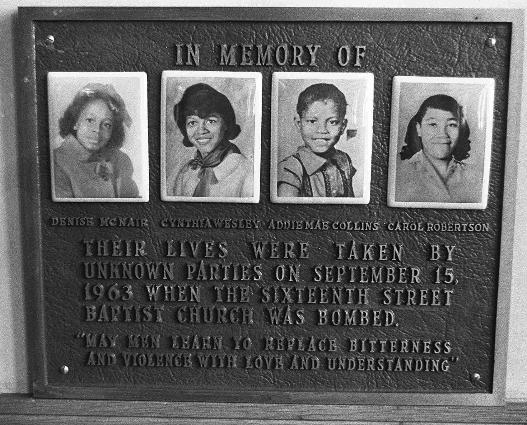
If you have been following this blog and the Civil Rights timeline, the reasons are insurmountable. On Sept. 15, 1963, the 16th Street Baptist Church in Birmingham, Alabama, was bombed after the KKK planted dynamite in the church’s basement. The bombing killed four young girls: Addie Mae Collins, 14; Denise McNair, 11; Carole Robertson, 14; and Cynthia Wesley, 14.
![]() |
| Plaque commemorating the four girls killed in the 16th Street Baptist Church Bombing |
News of the bombing shook the nation. Everyone, including Dr. King, heard what happened and then had to ponder: what kind of hate and racism would allow the killing of young girls at their church on a Sunday morning?
Yet despite the public outrage, it took years to convict the perpetrators of the crime. It has taken years more to answer other questions that the tragedy brings to the fore:
Have we as a nation made it possible for young people (of every color) to feel safer?
Are those who would use violence to further their ideology more likely to be brought to justice today?
Who else, or where else, might be a target for those looking to send a message of fear?
![]() |
| The aftermath of the dynamite explosion at 16th Street Baptist Church in Birmingham, Alabama |
The 16th Street Church bombing was a significant event in 1963, and it still has reverberations today. Coming after the successful Children’s March and Birmingham campaign (where the 16th Street Baptist Church played a critical role as a meeting place for activists) and the success of the iconic March on Washington, the bombing reminded many of how much work was left undone and how much harm activists were putting themselves in the way of. It also reminded many of what was truly at stake with civil rights: the ability not just to protect those 4 girls but all children so they can grow up in a world free from the dangers their skin color could cause.
In May 2013, President Barack Obama awarded the four girls The Congressional Gold Medal, one of the nation’s highest civilian honors. Read about this historic honor here.
That is one of the many ways the girls’ legacy is being honored. Today from 2:30-4:30 p.m. Levine Museum will host a screening of the film 4 Little Girls. The documentary, directed by Spike Lee, looks at the lives, loss and continued impact of the bombing.
Share your thoughts with us on Twitter @LevineMuseum. Follow along using the hashtag #DestinationFreedom.
You can also find us at Facebook.com/Levine Museum to RSVP to the screening and learn more about the Destination Freedom series.
See you on the 15th for the kickoff!
Sunday, September 1, 2013
Destination Freedom...The Artists Capturing the Civil Rights Movement
![]() |
| Hughes |
We can read it within the works of poet Langston Hughes, who depicted the activists, angst, letdowns and promise of the movement. A poet who burst to the national scene during the 1920’s-1930’s Harlem Renaissance, Hughes had long dealt with the themes of being black in America as well as freedom and equality in his writings.
His poem “Birmingham Sunday” (you can read here), looked at the events of the 16th Street Baptist church bombing, while the poem “Go Slow” responds to those who criticized the movement as being too confrontational—the same criticism that inspired Dr. Martin Luther King to write his “Letter from a Birmingham Jail.” In other works like “Freedom [3],” “Bombings in Dixie,” and “Death in Yorkville” about the 1964 death of James Powell, Hughes explored the many questions and contradictions of American democracy that the movement exposed.
Another author dealing with the events in 1963 in his works was Christopher Paul Curtis. His 1995 novel “The Watsons Go to Birmingham,” won a Newbery Honor and the Coretta Scott King Award for children’s literature in its depiction of a family that lives through the 16th Street bombing and has to find ways to deal with its emotional aftermath. The book has been turned to a television movie which will air on Sept. 20, 2013. Here is more information about the movie adaptation.
![]() |
| Lukova's "I Have a Dream" |
![]() |
| Public art at Kelly Ingram Park in Birmingham, Alabama |
How do you remember learning about the events of 1963?
What are some of your favorite artistic pieces that deal with the Civil Rights Movement?
If you were an artist, how would you choose to represent the civil rights events of then or now in art?
What are some of your favorite artistic pieces that deal with the Civil Rights Movement?
If you were an artist, how would you choose to represent the civil rights events of then or now in art?
Share your answers with us on Twitter @LevineMuseum. Follow along using the hashtag #DestinationFreedom.
Or visit us at www.Facebook.com/LevineMuseum to see how social media connects artists, museums and visitors to the stories of the past.
Subscribe to:
Posts (Atom)