Monday, July 30, 2012

The sport that came from Prohibition.

Most sports are created out of fun, but NASCAR was created out of the necessity of alcohol.

stillhousemoonshine-saloon
Prohibition banned the sale of alcohol, posing obvious problems for owners of bars and taverns. In retaliation to this law, many illegal bars opened up in hidden, obscure locations. 

During the Prohibition era, a time when the sell and consumption of alcohol was illegal, men and sometimes women still wanted their spirits. The idea of Prohibition was not recieved lightly, especially in the South. 


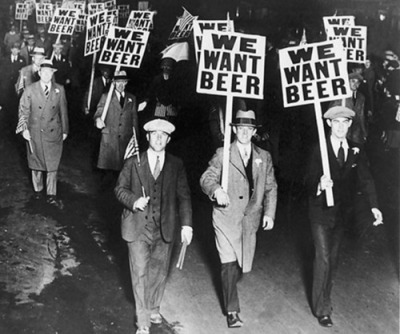
Prohibition generated a large number of protests. 
People were not going to stop drinking, even if they had to create the alcohol themselves. Moonshine became a business and livelihood of the people who would take the risks of brewing their own drinks. Proving to be extremely profitable, distillers would smuggle moonshine all throughout the South. 
Illegal moonshine manufactured in underground distilleries. 
In order to evade getting caught by the police, moonshiners would modify their cars, lowering their back ends, and would speed off in the eventual pursuit. If they got caught by the police, there went the money in order to feed their families. 


An example of a "moonshiner's" car.
The exhilaration of racing away from trouble, turned into fun. Eventually the people with their modified cars would race each other, but it was still a necessity to get away from the police. After Prohibition was deemed unconstitutional, alcohol was back to its original legal standing, but the idea of racing the modified cars was still appealing. Racing became a hobby and sport that would stand the test of time.


A race from the early days of NASCAR.
Check out the blog to see more about what came of racing!

Friday, July 27, 2012

Student protest, pickets and "Stop the War!"

This week's image deals with protests to the Vietnam War, right here in Charlotte, NC. 


The Civil Rights and Anti-Vietnam War movements provided models for the women's movement." Barbara Ferguson, Vietnam Protest Rally, Freedom Park 1969.
Many marginalized movements fed off of each other in the mid to late 1900s, hoping to achieve many rights which groups of people did not originally have. Protests such as these were held, usually with youths and college students, to get the points of equality across to the public. With the start of the Vietnam War in 1965, students, vets, men, women, black, and white started to shout "Stop the War."


Parades and gatherings were valuable tools to protest the war. 
American's did not see why the war was important for the US to be involved, and were tired of sending their men to a fight that was not theirs. Many times this was a chance for women to stand up for what they believed in because they were the mothers, wives, and daughters of the men who were getting sent and killed.

Most Vietnam protest signs would say things like "Stop the War," or some variation of it, but the sign held by the woman on the right says "No V.C. (Viet Cong) Ever Called Me N*gger." This is a quote from a famous speech made by Cassius Clay, who later became known as Muhammad Ali.


Muhammad Ali. 
Ali was a prize-winning US boxer and an opponent of the war. This was directly due to his beliefs with the Nation of Islam, which was also known as The Black Muslims group. Ali said he would not fight in the Vietnam war after being drafted, because his faith doesn't tell members to fight in wars not declared by Allah or The Messenger. Ali said this quote to show that he had no problem with VietCongs, but his problem is with those in the US that call him n*gger.


Needless to say, this time was a hotbed of political action from women, religious, and race leaders alike.

Wednesday, July 25, 2012

It all starts with just one voice, just one protest...

Sometimes even the most unassuming people might be partly responsible for changing the world. Look at the following photo, one of this week's images:


In it, you see two young women in the very front. In the background, you see a collection of diverse students, all from different races and backgrounds. Unanimous, though, is their collective unhappiness: this group is actively participating in a protest against the Vietnam War. Due to protests like the one documented above, as well as many exterior factors, the Vietnam War ended prematurely with a U.S. pullout in 1975. 

For more information on this image and the backstory associated with it, please check back in a day or two. 

Thank you for your attention. 

Tuesday, July 24, 2012

The Loray Mill: Textiles, strikes and worker's rights.

Good morning! Today's blog post will take you to Gastonia, a town just West of Charlotte, NC. Once there, we'll talk about an event that was crucial to both North Carolina and United States history, specifically in regards to worker's rights—the Loray Mill Strike in 1929.


Gastonia, NC.
In order to make as much money as possible, mill owners adopted a “stretch-out” policy towards their workers. In other words, mill owners reduced workers wages while increasing their responsibilities. Mill workers were often denied restroom and water breaks, and were expected to work near nonstop to reduce costs for the mill owners. Obviously, mill workers were very angry—they were being denied basic rights. 

The Loray Mill as it appeared in the early 1900s. 
Sympathizing with the problems of the average mill worker, the National Textile Workers Union (NTWU), a communist labor party, began to reach out to oppressed workers. Fred Beal, a representative of the NTWU, recognized the large number of unhappy workers in the small North Carolina town of Gastonia, and began working heavily in the region.

In March of 1929, the NTWU held its first public meeting in Gastonia, during which the union’s leadership began urging workers to object and stand firm. The meeting was very successful, as all of the workers in attendance voted to strike immediately. This plan began on April 1, 1929, when 1,800 workers from the Loray Mill in Gastonia walked away from their workplace to protest unworkable conditions. The striking workers demanded a minimum wage, the end of the stretch-out system, as well as the recognition of unions by mill owners.

This book was published by the National Textile Worker's Union in 1929. It was intended to raise support for the NTWU's cause and describes the conditions that caused the strike and the "terror" that followed afterwards. 
Irritated at their requests, mill owners ordered workers to vacate mill-owned housing, leaving protesters angry and defensive, as well as homeless. North Carolina Governor O. Max Gardner recognized tensions and deployed 250 National Guard troops to the Mill to maintain order. In the following months, the strike escalated, resulting in many acts of violence and continued resistance. The strike lasted until September of 1929, but was not a success.

This week's image: the Loray Mill Strike.
Violently suppressed by the government, this strike paved the way for the formation of the United Textile Workers. This union took many years to form yet, once organized, fought to protect the interests of mill workers.

Much like how a small rockslide can start an avalanche, this strike had significant consequences for the South and the United States, as a whole.


Obviously, this mill played a very important role in Southern history; just what happened to it?


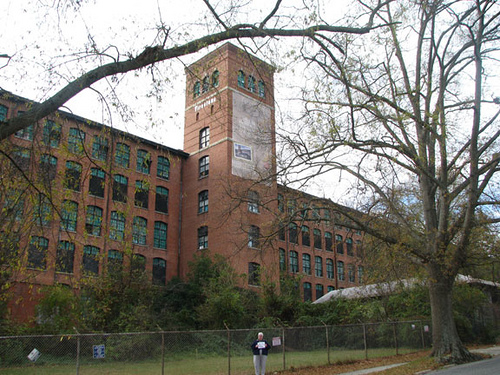
The Loray Mill as it stands today. 
In the 1930s, the Loray Mill was sold and repurposed, transforming into a tire factory. Instead of spinning cotton, the Mill now spun tire cord. In the 1990s, though, its future became uncertain. Firestone Tire Company, the previous owner, built a new manufacturing plant in Kings Mountain, a nearby town. Firestone donated the building to a historic preservation society, but no buyer could be found. The building continually set vacant until a plan was developed and put into action this past June.


The future Loray Mill.
Camden Development Partners, a group based in Atlanta, has received a financial commitment to begin the Loray Mill Project. This project, depicted above, will create 190 loft apartments and over 79,000 square feet of commercial space. Residents in Gastonia hope that this will become a centerpiece to Western Gastonia, reviving the previously-struggling district. 


The first phase of this project is schedule to be completed by late 2013.


The Loray Mill interior presently. Imagine the possibilities!
For more information, here are two links to respective news articles about this new project:


1.) An article from the Charlotte Observer: http://www.charlotteobserver.com/2012/07/05/3362558/saving-gastonias-loray-mill-a.html 


2.) An article from WBTV: http://www.wbtv.com/story/18876220/gastonias-loray-mill-to-be-transformed-into-apartments-commercial-space 

Friday, July 20, 2012

'We want change!' Mill strikes and protests in the South.

This weeks image deals with the idea of workers rights as a whole, and those that fought for them.


Once the South started to industrialize, workers realized that a job in the mills was not much better than working on the farm. This was disappointing since many people fled to the mills because they were finally able to make a steady wage, instead of getting paid only once a year. They could have a job, a home, food, and money to live off of, on a monthly bases. Although this prospect of a new life seem perfect at the time, once the work started, so did the problems.


Children, teenagers, and adults all worked alongside each other. The mills were filthy, hot, and dangerous. The wages the workers were receiving were very small, and most of the money went back to the mill owners. The mill owners owned the town, the houses, and the stores. The wages, which were paid to the workers, were then spent at the stores and on the rent for the houses. Many people were extremely unhappy with this system, but could not fight against it because that would mean loosing their jobs and homes. They were 'owned' by the mill owner.  


Eventually, seeing the problems with the systems, workers began to group together with the common goal of better working conditions. Keep posted for the next blog that will go into the strikes and protests that would change the South, with lasting impressions today.

Thursday, July 19, 2012

Despite changing times, Latino culture perseveres.

In the past few decades the number of Latinos that have immigrated to America has grown enormously. In this picture a Latin American family is celebrating a confirmation celebration. In the Catholic and other Christian traditions certain rites of passage, or rituals that mark a status change, are done with families and are large celebrations. many of these events include colors that symbolize ‘cleansing’ and ‘new beginning,’ such as white does in this photo. There are also symbols such as candles and clothes that are worn for the festivals. In Catholicism Confirmations are usually done to a baptised youth when they are 14. This is the age when they are accepted as an adult into the church. Many religions such as Judaism have similar rituals and rite of passage into the faith communities.


Luis Rey Velasco is the photographer. He is a graduate of East Carolina University and has worked photographing Latino families. He has focused on how these families carry their traditions in the changing New South that is now their home. Despite the influx of various cultures and diverse people into the New South, Velasco's photographs illustrate how  traditional Latino cultures are preserved, creating a strong sense of community among the population.

For more information on the photographer, you can view his website:

http://www.luisreyvelasco.com/

Tuesday, July 17, 2012

The New South Latino community.

This week, for the Summer Virtual Series, we will be looking at the Latino community that is rapidly growing in the South. For the last two decades, more and more Latino immigrants are coming to the South and with them their cultures and traditions. From religion, family, food, and friends, the Latin American community shows that strong roots will never change. Keeping their traditions alive, Latinos practice their own forms of them and incorporate Southern customs, as well. Southern states have accommodated the growing number of immigrants in a variety of ways, such as Latin women's associations, Hispanic Chamber of Commerce, and Latino Immigration Studies, among others. These groups help new immigrants settle into their new lives in the South.


This week, the image focuses on the standing traditions that keep the Latino community alive. Stay posted for the next blog!